





If you’re doing both cardio and strength training, you’ve probably wondered: does the order actually matter? It does and getting the sequence right can make a real difference in your results. The short answer: most women should do strength training first, then cardio second. But like most things in fitness, the full answer depends on your goals. Here’s how to figure out the right approach for you.
Key Takeaways
- Most women should do strength training first and then cardio for optimal results.
- Strength training requires fresh muscles and focus, while cardio first can lead to fatigue and poor lifting form.
- In endurance events, prioritize sport-specific training before strength workouts, but keep them separate for best performance.
- Balancing both training types calls for strategic programming, ideally separating sessions or following a strength-first approach.
- Common mistakes include doing intense cardio before lifting or not allowing enough recovery time between sessions.
Why the Order Matters
When you strength train, you need to be fresh. Your muscles need energy, your nervous system needs to be sharp, and you need to lift with good form. When you do intense cardio first, you burn through energy stores, build up fatigue, and tire out your nervous system. Then when you try to lift weights, you can’t lift as heavy, you can’t do as many quality reps, and your form suffers. The result: you get less out of your strength training.
But if you lift weights first? You get your best strength work in while you’re fresh. Then you can still do effective cardio afterward, moderate-intensity cardio works fine even when you’re a bit tired from lifting.
Strength First, Cardio Second: The Default Approach
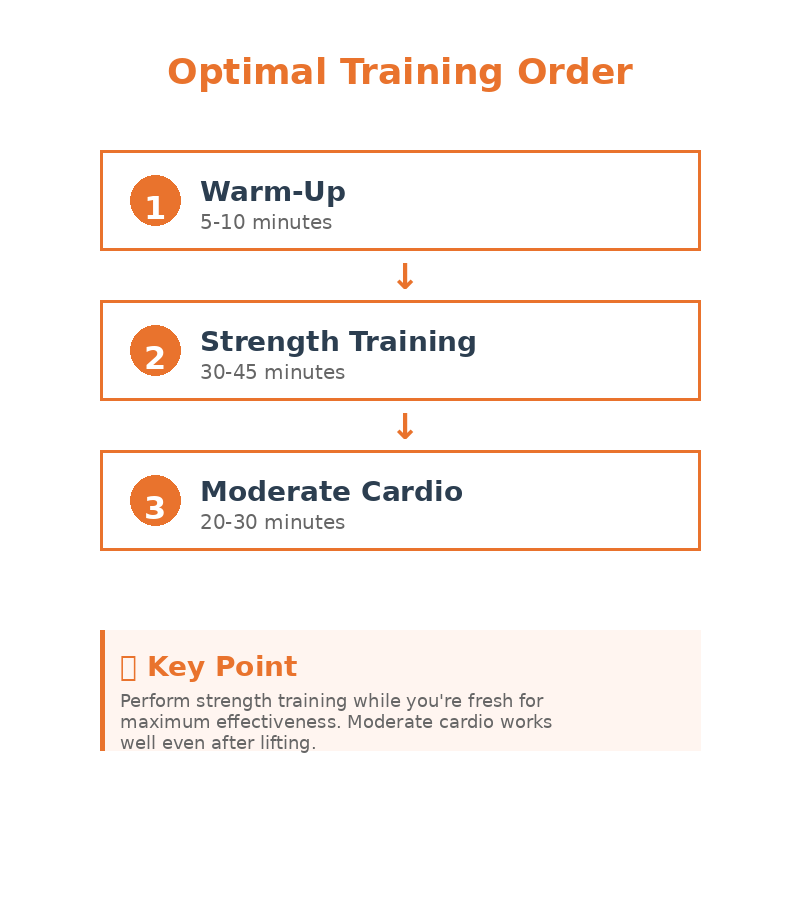
Do your strength training first, then cardio is the best approach for most women who are combining both types of training, especially if building strength is one of your main goals.
Why? You’re fresh for the training that matters most. Strength training needs maximum effort and focus, qualities that drop off fast when you’re tired. By lifting first, you get quality work that actually builds strength.
A study found that doing cardio before weights led to weaker strength gains. But when people did strength training first, their cardio fitness (VO2 max) wasn’t negatively affected. Your form stays good during weighted exercises. When you’re tired from cardio, your technique gets sloppy during lifts, which increases injury risk and makes training less effective. Lifting fresh keeps your movement quality high.
You still get cardio benefits even after lifting. Moderate cardio (where you can still talk comfortably) works well even after strength training. Your body still adapts to the cardio stimulus whether you do it first or second. Recovery stays manageable. High-intensity cardio before lifting creates competing demands on your body’s recovery. Moderate cardio after lifting fits within what your body can handle.
How to do this in practice
Finish your complete strength workout (warm-up, main lifts, accessory exercises) before starting cardio. Then do 20-30 minutes of moderate cardio—a pace where you can still hold a conversation, not gasping for air. Keep cardio under 40 minutes so you don’t create too much fatigue that affects your strength training recovery.
This works especially well if your main goal is building strength while staying generally fit, you’re new to combining both types of training, or you’re focused on building muscle and improving your metabolism.
If you’re balancing both strength training and running or other endurance sports, see our complete guide on combining gym and running for more detailed programming strategies.
When to Do Cardio First Instead
Some situations call for flipping the order but these are specific exceptions, not the general rule.
- Your main goal is endurance or race performance. If you’re training for a race (marathon, half-marathon, triathlon), your running or cycling matters more than your strength training. Do your sport-specific work first when you’re fresh, then add strength training as supplemental work for injury prevention.
- You’re doing very light cardio as a warm-up. A 5-10 minute easy warm-up on the bike or rower is fine before lifting. This is different from a full cardio session. You’re just warming up, not working out. If you’re breathing hard or sweating a lot, you’ve gone past warm-up intensity.
- You have limited time and cardio is your priority. If you can only train 3 days a week for 45 minutes and your main goal is cardiovascular health (not strength), it makes sense to prioritize cardio. Just know you’re choosing cardio adaptations over strength gains—which might be the right choice for your situation.
How to handle these scenarios:
- For endurance athletes: Do your running or cycling first, then 20-30 minutes of strength training focused on injury prevention—compound movements and single-leg stability work.
- For warm-up cardio: Keep it to 5-10 minutes max at very easy intensity. You should feel warmed up but not tired. If you’re breathing hard, you’ve done too much.
- For time-limited cardio priority: Understand you’re making a trade-off. Your strength gains will be slower, but if cardio fitness matters more for your goals right now, that’s okay.
The “Interference Effect”
When you do a lot of cardio and strength training close together, they can interfere with each other—researchers call this “concurrent training interference.” This was first documented back in 1980 when a study showed that untrained men who did both cardio and weights didn’t gain as much strength as men who only lifted weights.
But here’s the good news: more recent studies show that combining cardio and strength training doesn’t actually hurt muscle or strength gains when you program it smartly. The interference effect mainly shows up when you’re doing high-volume, high-intensity cardio right alongside your strength training.
What this means for you:
If building muscle and strength is your main goal, doing too much cardio especially high-intensity intervals can slow your progress. Research shows the interference effect is strongest when you combine intense HIIT workouts with high-rep strength training. Keep your cardio moderate: 20-40 minutes of steady-state work, 2-4 times per week.
If endurance or race performance is your main goal, smart strength training actually helps your performance without hurting your endurance gains. Aim for 2-3 strength sessions weekly with compound movements and functional exercises.
If you want to improve both strength and cardio fitness reasonably well, you need balanced programming without overdoing either one. This means smart scheduling across your week, not just within each workout. Research shows that cardio only impacts strength gains for trained individuals when performed within 20 minutes of resistance training—but this impact disappears when the workouts are separated by several hours.
How to schedule to minimize interference:
Separate cardio and strength into different sessions when you can. Lifting in the morning and doing cardio in the evening (or vice versa) gives your body more recovery time between workouts. Research suggests that running might interfere more with muscle building than cycling, possibly because of the impact and muscle damage from running.
If you can’t train twice in one day, wait at least 6 hours between workouts. For example: lift at 7am, do cardio after work at 5pm. When you must combine both in one session, stick with strength first, cardio second, and keep the cardio moderate in intensity and duration.
Specific Scenarios and Recommendations
Scenario: Building Strength While Maintaining General Fitness
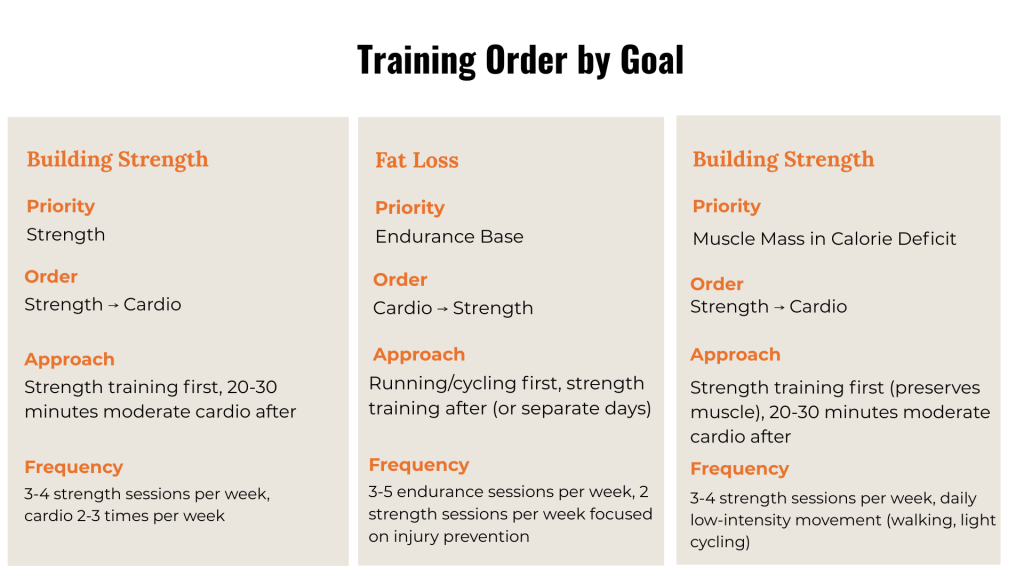
If building strength is your main goal, prioritize the quality of your lifting sessions above all else. Do your full strength workout first while you’re fresh, then add 20-30 minutes of moderate cardio afterward. Aim for 3-4 strength sessions each week with cardio 2-3 times per week—this gives you enough volume to build strength without letting cardio interfere with your recovery.
Scenario: Training for Endurance Event (Marathon, Half-Marathon, Triathlon)
If you’re training for a marathon, half-marathon, or triathlon, your running or cycling takes priority. Do your endurance work first when you’re fresh, then add strength training afterward or better yet, schedule them on separate days entirely. Plan for 3-5 endurance sessions each week with 2 strength sessions focused specifically on injury prevention rather than maximum strength gains. For detailed guidance on balancing strength and endurance training, see our beginner strength training guide.
Scenario: Fat Loss and Body Composition Improvement
When you’re trying to lose fat, your priority is preserving muscle while creating a caloric deficit. Do your strength training first—this sends a signal to your body to keep that muscle tissue—then add 20-30 minutes of moderate cardio afterward. Aim for 3-4 strength sessions each week, and fill in the gaps with daily low-intensity movement like walking or light cycling. This approach keeps your metabolism up while the calorie deficit does its work.
Scenario: Limited Time (30-40 Minutes Per Session)
When you only have 30-40 minutes per session, your approach depends entirely on which goal matters more right now. If strength is your priority, dedicate the full 30 minutes to lifting and skip separate cardio—just add a quick 10-minute finisher at the end if you have energy left. If cardiovascular fitness matters more, flip it: do 20 minutes of cardio first, then spend 15 minutes on compound strength movements that give you the most bang for your buck.
Scenario: Busy Professional With Unpredictable Schedule
When your schedule is unpredictable, consistency matters more than perfection. Try to separate your cardio and strength sessions when your calendar allows—morning lifting and evening cardio, for example, or lifting on Monday and cardio on Tuesday. But on days when you need to combine both, stick with the strength-first approach and add a brief cardio session after. Your main focus should be getting in 2-3 quality strength sessions each week no matter what, then fitting in cardio whenever opportunities arise rather than forcing it into an already packed schedule. For remote training options that accommodate unpredictable schedules, the Virtu program provides flexible programming that adapts to your availability.
How to Structure Your Week
How you set up your whole week matters just as much as what you do in each workout. Smart weekly planning prevents you from getting too tired while still giving your body enough stimulus to get stronger and fitter.
Sample Week: Strength Priority
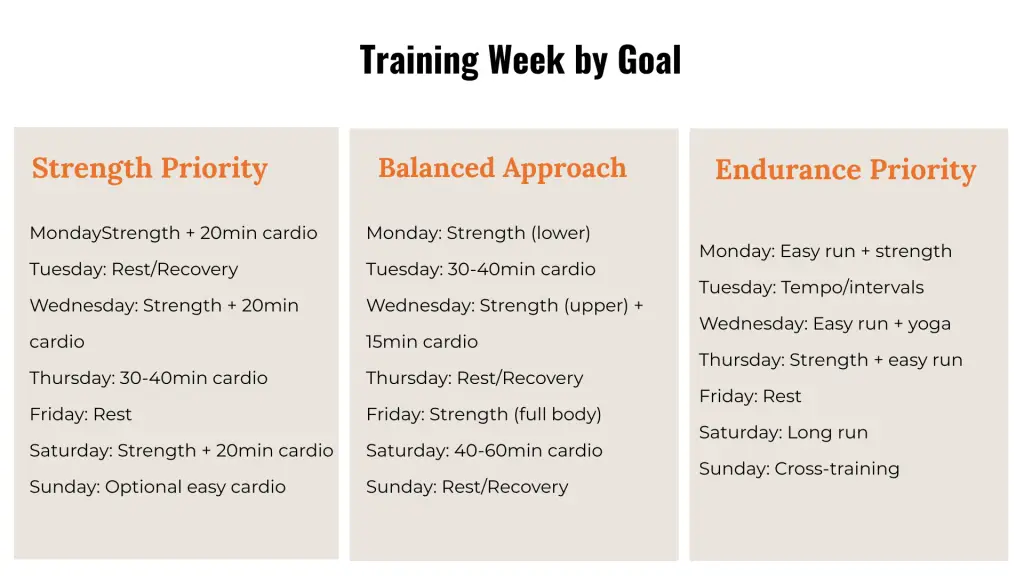
Monday: Strength training (full body or lower body), 20 minutes moderate cardio after Tuesday: Rest or active recovery (walking, yoga) Wednesday: Strength training (full body or upper body), 20 minutes moderate cardio after Thursday: 30-40 minutes moderate cardio only Friday: Rest Saturday: Strength training (full body), 20 minutes moderate cardio after Sunday: 30-40 minutes easy cardio (optional)
Sample Week: Balanced Approach
Monday: Strength training (lower body) Tuesday: 30-40 minutes moderate cardio Wednesday: Strength training (upper body), 15 minutes easy cardio after Thursday: Rest or active recovery Friday: Strength training (full body) Saturday: 40-60 minutes moderate cardio Sunday: Rest or active recovery
Sample Week: Endurance Priority
Monday: Easy run (30-45 minutes), strength training (20-30 minutes injury prevention focus) Tuesday: Tempo run or interval work Wednesday: Easy run, optional yoga or mobility work Thursday: Strength training (full body, 30 minutes), easy run (20 minutes) Friday: Rest Saturday: Long run Sunday: Easy cross-training (cycling, swimming)
Common Mistakes to Avoid
Mistake #1: Doing Hard Cardio Before Heavy Lifting
Don’t do sprints, hill runs, or hard intervals before trying to squat or deadlift. This burns through your energy and tires out your nervous system, making it harder (and less safe) to lift heavy weights.
Mistake #2: Doing Too Much Cardio After Lifting
Don’t do 60-90 minutes of cardio after a full strength session. This creates too much total stress for your body to recover from. Keep post-strength cardio to 20-40 minutes max at moderate intensity.
Mistake #3: Treating Warm-Up Cardio and Real Cardio the Same
A 5-minute easy bike ride to warm up is completely different from a 30-minute cardio workout. Don’t skip light warm-up cardio because you’re worried about getting tired—proper warm-up actually helps your strength training.
Mistake #4: Always Combining Everything in One Session
If your schedule allows, split cardio and strength into different sessions (different days or different times of day). This gives better recovery and reduces the interference effect.
Mistake #5: Not Taking Enough Rest
Don’t do combined cardio and strength sessions back-to-back every day. Your body needs recovery time to adapt. Take at least one full rest day each week, and avoid doing high-intensity work on consecutive days.
Pay Attention to How Your Body Responds
Everyone responds differently to combined training. Some women handle it great, others find one type of training interferes with the other. Watch for these signs: Are you still getting stronger in the gym week to week? If your strength progress stalls even though you’re training consistently and eating enough, you might be doing too much cardio or going too hard. Are you recovering well between workouts? Constant fatigue, dropping performance, or higher resting heart rate means you’re doing more than your body can handle right now. Are you constantly sore or feel like your muscles never fully recover? You might need more rest between combined sessions. Is your cardio fitness improving or at least maintaining? If your cardio performance drops even though you’re doing regular cardio, you’re probably not recovering enough from the combined training stress.
What to Do Next
Start with the default: strength training first, moderate cardio after, 2-3 times per week. Give it 4-6 weeks and see how you feel. Then adjust based on your goals and how your body responds.
If strength is your priority and you’re not making progress, cut back on cardio volume or intensity, or separate cardio and strength into completely different sessions. If cardio fitness matters more and you’re training for races, do your sport-specific work first when you’re fresh, then add shorter strength sessions focused on injury prevention.
For expert guidance on structuring training that balances multiple goals without overwhelming your recovery, personalized coaching can help. The Core program provides coaching for women building strength, while the Flex program specifically addresses balancing strength and endurance training for athletes.
Book a free discovery call to discuss how customized programming can optimize your training based on your specific goals and circumstances. Not sure how to structure your sessions? A personal trainer in Toronto can build a programme that sequences your cardio and strength work properly for your goals.
FAQs About Cardio and Strength Training Order
Yes, most women can do both in one session using the strength-first, cardio-second approach. Just keep your cardio moderate (20-40 minutes) so you don’t get too tired. Splitting them into separate sessions works better if your schedule allows, but combined sessions work fine when set up right.
The “fat burning zone” thing is overblown. What matters more is total calories burned and training consistency, not trying to manipulate what fuel you’re using during a specific workout. Strength first, cardio second gives you better strength results while still providing cardio benefits—that’s a better long-term approach than obsessing over fat oxidation.
In a combined session, no waiting needed, go straight from lifting to cardio with minimal rest. If you’re splitting them into two separate sessions on the same day, wait at least 6 hours between them.
Light to moderate cardio on strength rest days can actually help recovery by increasing blood flow. Just keep it easy enough that you can talk comfortably the whole time. Don’t do hard cardio on consecutive days with strength training, you need recovery time.
This needs strategic programming that balances both without overdoing either. Prioritize strength training 3 times per week with progressive overload. Add 2-3 moderate cardio sessions (20-40 minutes) that don’t interfere with your strength work. Accept that progress in both areas will be slower than if you focused on just one, but you’ll be well-rounded.
Yes, most women can do both in one session using the strength-first, cardio-second approach. Just keep your cardio moderate (20-40 minutes) so you don’t get too tired. Splitting them into separate sessions works better if your schedule allows, but combined sessions work fine when set up right.
The “fat burning zone” thing is overblown. What matters more is total calories burned and training consistency, not trying to manipulate what fuel you’re using during a specific workout. Strength first, cardio second gives you better strength results while still providing cardio benefits—that’s a better long-term approach than obsessing over fat oxidation.
In a combined session, no waiting needed, go straight from lifting to cardio with minimal rest. If you’re splitting them into two separate sessions on the same day, wait at least 6 hours between them.
Light to moderate cardio on strength rest days can actually help recovery by increasing blood flow. Just keep it easy enough that you can talk comfortably the whole time. Don’t do hard cardio on consecutive days with strength training, you need recovery time.
This needs strategic programming that balances both without overdoing either. Prioritize strength training 3 times per week with progressive overload. Add 2-3 moderate cardio sessions (20-40 minutes) that don’t interfere with your strength work. Accept that progress in both areas will be slower than if you focused on just one, but you’ll be well-rounded.