

Ever since COVID, there has been a rise in mobile personal training, not just in Toronto, but also across Canada and USA. People feel more comfortable training at home. They don’t want to spend time in commute and prefer having an in-home personal trainer professional come to them instead. Most of our staff works out of downtown locations, where condos and apartments are much smaller in space and so knowing what you need vs not in your space to make it training ready can save you a lot of money and guesswork.
Here are a few things that our expert in-home personal trainers recommend to have for your home gym:
The Essentials
The Space
The first thing to assess is how much space you have. The most common areas to train in condos are dens or smaller second bedrooms. We generally prefer a room that has a sturdy door because that comes in very handy later when we discuss our equipment setup. Also, you need enough space to lie down on a mat without bending yourself or not reaching with all your fours. Ideally your space has enough room to take a few steps back and forth, but if not available that is totally fine.
Equipment You Need & Why
Resistance Bands
There are generally three ways to use resistance in strength training. You can use bands, dumbbells, or plates to achieve the same resistance. Elastic rubber bands are usually the safest option to start. They significantly reduce injury risk compared to free weights. It also doesn’t take up a lot of space and you can combine bands of different tensions to increase resistance of your exercise.
Our personal trainers recommend two types of bands. The first one that’s fabric resistance bands, they are looped bands that sit around your ankle and knees. They come in light, medium and heavy. They are much more durable compared to the plastic ones. Here’s what our expert personal trainers recommend to clients. With these alone you can do glute bridges, clamshells, lateral leg raises, and banded squats, which covers most of the hip and glute activation work needed for lower body workouts. Here’s our in home personal trainers’ top recommendation for fabric resistance bands.
The second type we recommend is resistance bands with door anchor. These are a set of bands that come in different weights (10 to 50 lbs) and has a door anchor that turns your home into a moving cable machine.
By adjusting where the bands are anchored at the door, you can do reverse flies, shoulder raises, chest press, lat pulldowns, and rotational chops for your core. It also comes with ankle straps for glute kickbacks, and leg curls. That’s upper body pulling, pushing, core rotation, and lower body posterior chain all from the same kit. Here’s our top recommendation for resistance bands for in-home personal training.
Dumbbells
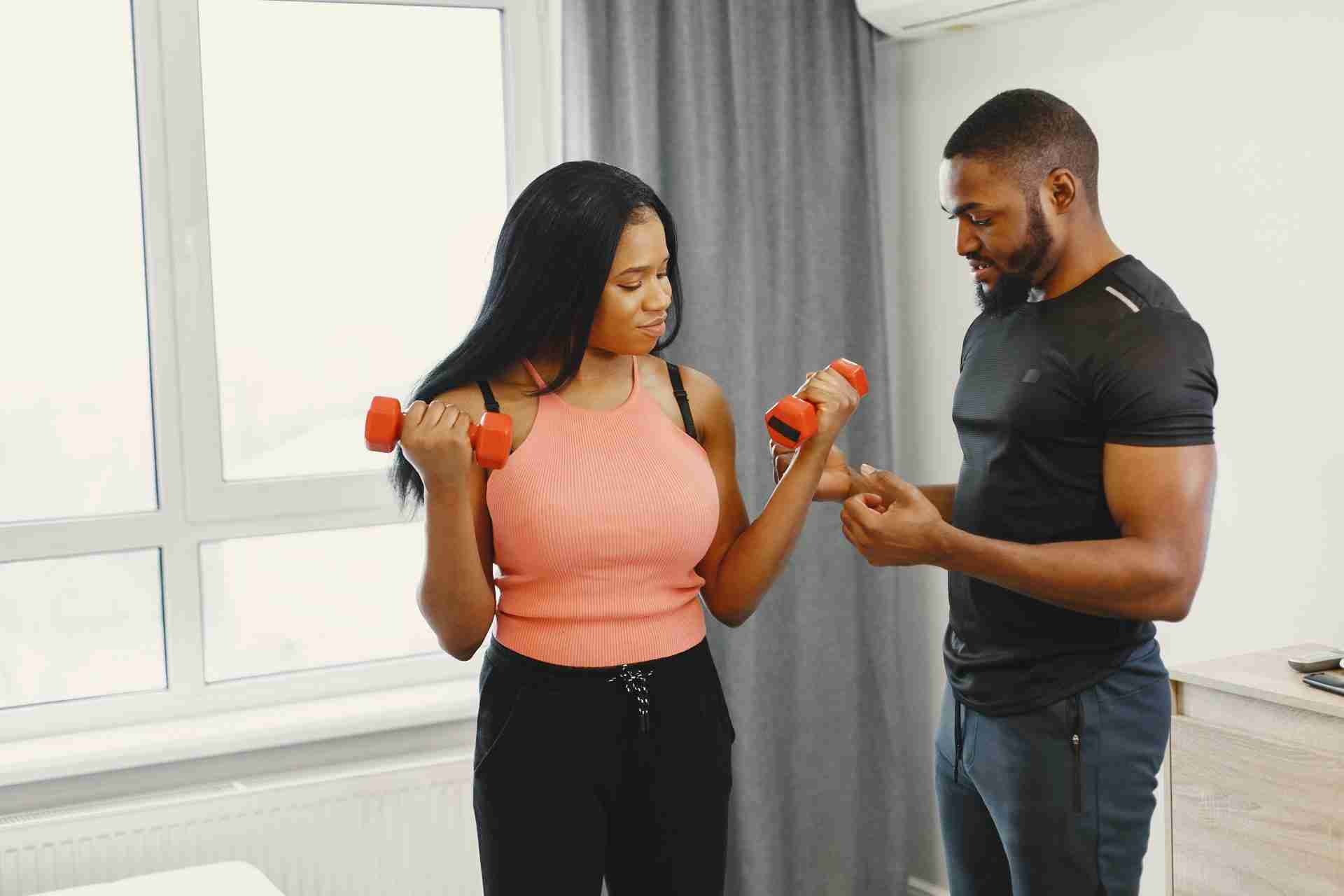
Dumbbells are also another way to add resistance. You can buy dumbbells of different weights separately, which often takes up a lot of space. You may need to buy a rack to keep them organized or buy the adjustable ones that go from 5lbs to 80-100 lbs. They are much more compact, but some find them uncomfortable because they can feel unstable. With dumbbells you can do pretty much all exercises; squats with its variations, presses, rows, deadlifts, etc. As you get stronger, you can adjust the weight by adding resistance bands looped around the dumbbells. This is our head coach Marwa Ahmed’s top method for working out with maximum resistance & adaptation. Here’s our favourite set of adjustable dumbbells.
One thing about adjustable dumbbells is that they usually start from 5 lbs so if you are a beginner to strength training and want lighter weights then you need to buy them separately. The lightest you can get is 1 lb and it can go up to 3 lbs.
Mat
A mat is also needed for any exercises in (prone or supine positions) for core and glute training. This includes bridges, clamshells, bird dogs, planks, dead bugs, leg raises, etc.
Look for ones that have good cushioning. This is especially important if your floors are hard or experience any type of pain in your knee or elbows when applying pressure on them. Another important factor is grip strength on the ground. This is more of a safety concern, but look for ones that have strong grip especially on hardwood so you don’t slide. This is what our clients use the most.
Bench
Lastly, although not a hard essential, a foldable bench would be a great piece of equipment for your setup. It can be used to do all your presses with good back support as people usually arch their lower back when they are doing presses unsupported. Also, a bench is the ideal option when doing split squats. Our personal trainers say they have seen people doing it on a chair, couch or even a step. But all of them are not as comfortable as a bench because of padding and height difference. Here’s our top recommendation for foldable benches.
Nice To Have
Although you have a very comprehensive setup with the equipment mentioned above, a few additional things you can add to make your setup even more complete are:
Slant Board
A slant board is a wooden angled platform you stand on where your heels are elevated and your toes are pointed up. It is usually commonly bought by people to stretch their calves but it has much more to it than that. For example, if your squat depth is limited by your tight ankles, a slant board can help you reach lower depth. It is also a common recommendation given by personal trainers who specialize in exercise science and physical therapists for knee rehab, especially after patellar tendon injury. You can also do single leg calf raises on it, which gives you better range of motion compared to a flat surface. Additional exercises you can do on slant boards are anterior tibialis raises and elevated split squats. Look for very study Slant Board like this.
BOSU Ball
The half moon ball that you see in some of the gyms and fitness studios. BOSU balls can be a great addition to your home workouts with an in-home personal trainer. It adds challenge to stability, balance and coordination. It’s particularly good for ankle rehab, proprioception work, and core exercises, where you want more challenge and coordination without adding load. You can keep the flat side down, and the dome side up or flip it if you want more challenge in instability. Exercises you can do are single-leg balance holds, BOSU squats, push-ups on the dome, plank variations, step-ups, lateral shuffles, bird dogs with instability. Here’s the most popular BOSU Ball option.
Massage Gun
Recovery is half of training, and a good recovery routine is what builds lasting strength and longevity. There are various forms of recovery available now and especially in Toronto — sauna, cold plunges, massage therapies, yoga, etc. More on recovery — coming soon.
A massage gun can help you break down muscle tension post workout, improve blood circulation and reduce soreness between workouts. This is especially true if you train more than 3-5 times a week. Remember that this is not a replacement for proper rest, nutrition and sleep, but can be a great addition to your recovery routine. It’s particularly useful on areas that tend to be very tight such as hip flexors, upper back, calves, and glutes.
Make it part of your evening routine. Build the habit of doing 10-15 minutes on workout days, and you’ll start to notice a difference over time in how tense your body feels. Here’s our top recommendation for a massage gun. Here’s our top expert recommendation for massage guns.
What about cardio?
Do you need a cardio machine at home? For most people, the answer is no. There are other forms to do your cardio training, such as jump rope, bodyweight circuits that are high intensity, or outdoor running/walking. For general fitness and longevity, combining your strength program with outdoor fitness such as running or fast walking is enough to cover a solid base. No machine is necessarily required, but there is a caveat.
People usually assume slow walking is cardio, when it is not, and that’s why it’s worth mentioning zone training. Zone training refers to the five heart rate zones in which you exert effort, they range from zone 1, low aerobic work to zone 5 or sometimes 6 in some watches which is near-maximal effort.
The two zones worth focusing on when working out at home with an in-home personal trainer are:
Zone 2
Low intensity, conversational pace, nose breathing. This is where your aerobic base gets built. You can do this with a brisk walk, light jump rope, or easy cycling. Ideally 30-45 minutes. Most people don’t do nearly enough of this.
Zone 4-5
High intensity intervals. Short bursts at near-maximal effort with recovery periods. Bodyweight circuits, jump rope intervals, or sprint repeats outdoors work well. 15-20 minutes is plenty.
You don’t need a machine for either. A heart rate monitor or smartwatch tells you which zone you’re in regardless of what you’re doing. More on this: Zone Training: A Complete Guide — coming soon.
Read: Cardio Before or After Weights?
The exception is if you’re training for a specific endurance goal — like the Scotiabank Waterfront Marathon, the Sporting Life 10K, or a Toronto triathlon — or you’re dealing with harsh winters like ours in Canada.
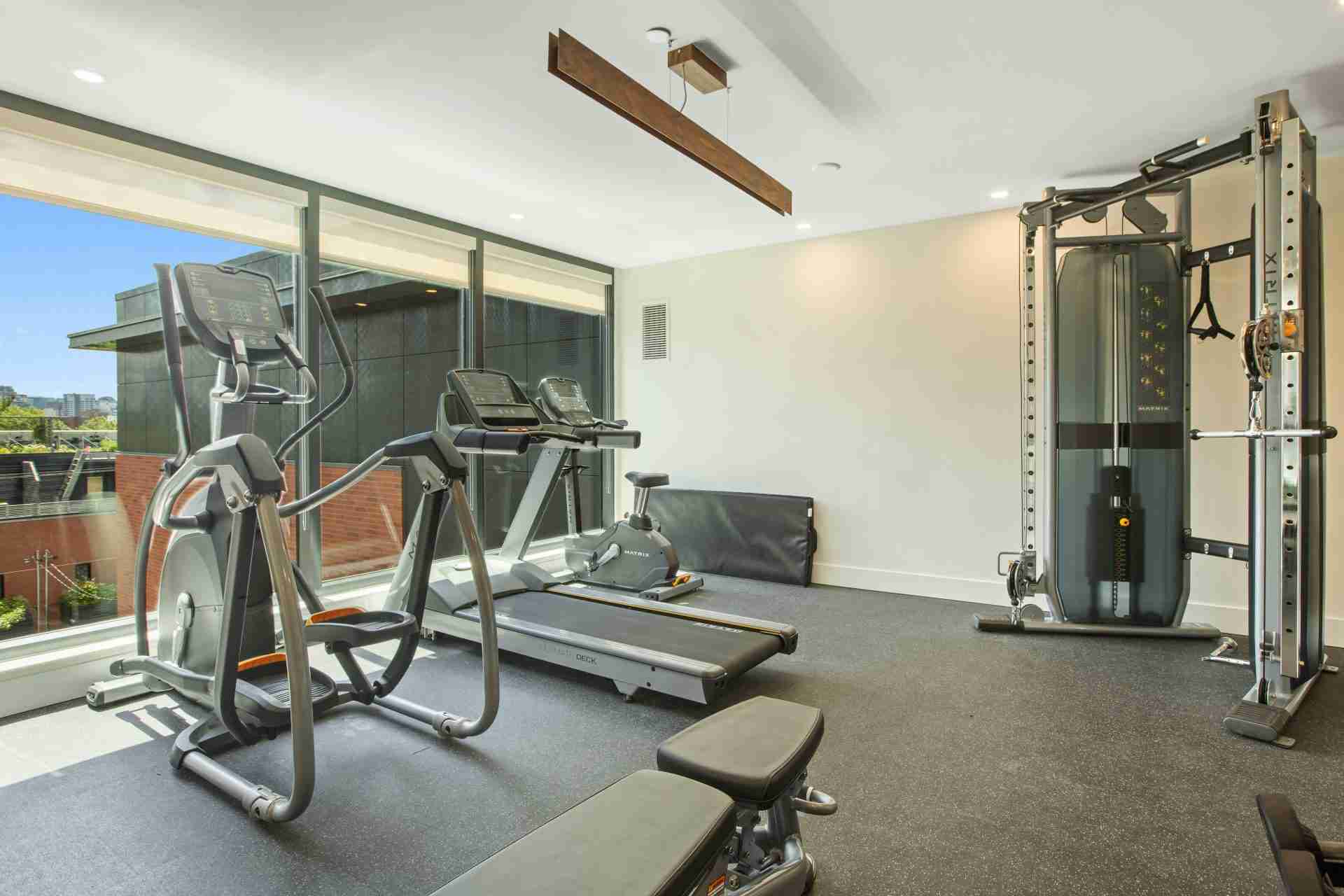
In Toronto and across most of Canada, outdoor training becomes genuinely difficult for a good 4-5 months of the year. Running in -20°C windchill with icy sidewalks isn’t realistic for most people and can be very difficult. For that reason, having a cardio machine at home can solve that problem and keep your training consistent in winter. In that case it’s worth investing in the right treadmill for your space.
Read: Best Compact Treadmills for Home Training — coming soon.
A common question we get is should we get an elliptical or a treadmill, and the answer is it depends on your goals — we wrote a full article to tackle this here.
Read: Elliptical vs Treadmill — Which One Is Actually Worth It? — coming soon.
Getting Started with In-Home Personal Training
Most people think that they need a full gym setup to see results from in-home personal training. They don’t. What you actually need is a strength program that’s built around your body — your imbalances, your current fitness level and your goals, and the consistency in working out and following the program.
That’s why at The BodyMind Coach, we always start with a comprehensive full-body assessment. We look at how you move, what your weaknesses are, and what your body actually needs to perform its best and build long-term health and longevity. From there, we build a program that works for your space, your schedule and your goals.
If you’re looking for an in-home personal trainer in Toronto, book a free discovery call and we’ll take it from there. (Learn more about Core for 1-on-1 in-person training or Virtu if you prefer remote coaching.)