



Most women have been told to “just push through” their periods or “take it easy” during their cycle. Both approaches miss something important. Working out on your period, and throughout your entire cycle , isn’t about pushing harder or backing off by default. It’s about understanding that your menstrual cycle is a monthly rhythm of hormonal changes that directly affects your energy, strength, recovery, and how your body responds to training.
Working out on your period is not only safe for most women, it can actually reduce cramps, improve mood, and maintain your training momentum. The key is knowing how to adjust. Here’s how to train smarter across each phase of your menstrual cycle, and why it matters for your long-term progress.
Key Takeaways: Working Out on Your Period
- Your menstrual cycle affects energy, strength, and recovery; align training with its phases for optimal performance.
- During menstruation, scale back intensity if you experience severe symptoms, but moderate exercise can help alleviate cramps.
- The follicular phase is ideal for strength training; push hard during this time and test personal records around ovulation.
- In the luteal phase, focus on maintenance over intensity; adjustments can help manage PMS symptoms and fatigue.
- Listening to your body is crucial; track your cycle responses to optimize workouts and avoid comparing your experience to others.
Understanding Your Menstrual Cycle Phases
Your menstrual cycle has four distinct phases, each with different hormonal profiles that affect how your body performs and recovers. The average cycle lasts 28 days, though anywhere from 21-35 days is normal.
Phase 1: Menstrual Phase (Days 1-5)
This is when you’re actively bleeding. Both estrogen and progesterone are at their lowest levels. Many women experience cramping, fatigue, and lower energy during the first 1-2 days, though this varies significantly between individuals.
Phase 2: Follicular Phase (Days 1-14)
This phase actually overlaps with menstruation, starting on day 1 of your period and continuing until ovulation. Estrogen rises steadily throughout this phase. As estrogen increases, many women notice improved mood, higher energy levels, and better strength gains from training.
Phase 3: Ovulation (Around Day 14)
Ovulation occurs roughly midway through your cycle when estrogen peaks and luteinizing hormone surges to trigger the release of an egg. This is typically when women feel their strongest and most energetic. Performance metrics often peak during this window.
Phase 4: Luteal Phase (Days 15-28)
After ovulation, progesterone rises while estrogen remains moderately elevated then drops. This is the phase leading up to your next period. Many women experience PMS symptoms during the late luteal phase: bloating, mood changes, food cravings, fatigue, and reduced motivation to train.
How Hormones Affect Your Training
Estrogen and progesterone don’t just regulate your reproductive system. They significantly impact metabolism, body temperature, fluid retention, inflammation, muscle protein synthesis, and recovery.
Estrogen’s Effects on Training
Estrogen is anabolic, meaning it supports muscle growth and repair. When estrogen is high (follicular phase and ovulation), your body builds muscle more efficiently, recovers faster, and can handle higher training volumes. Estrogen also improves insulin sensitivity and promotes the use of fat for fuel during lower-intensity exercise. High estrogen levels correspond with improved strength, power output, and endurance capacity. This is why many women set PRs and feel their best during the follicular phase or around ovulation.
Progesterone’s Effects on Training
Progesterone increases body temperature slightly, which is why you might feel warmer during the luteal phase. This rise in body temperature (typically 0.3-0.5°C) increases your resting metabolic rate as your body works to maintain that higher temperature. Research suggests this translates to burning approximately 100-200 extra calories per day during the luteal phase, though individual responses vary. Progesterone also promotes protein breakdown rather than protein synthesis, which can make muscle recovery slower.
Progesterone can also affect your central nervous system, contributing to feelings of fatigue and reduced motivation. It makes intense training feel harder than it would during the follicular phase, even if your actual physical capacity hasn’t decreased significantly.
Training During the Menstrual Phase (Days 1-5)
Working out on your period starts here, the first day or two is often the most challenging especially if you experience significant cramping or heavy bleeding. After the initial days, many women actually start feeling better as estrogen begins to rise.
What Your Body Can Do
Despite lower hormone levels, you’re not necessarily weaker during menstruation. If you’re not experiencing severe symptoms, your actual physical capacity may be similar to other phases. Some women find that moderate exercise actually helps reduce cramping and improves mood during their period.
How to Adjust Your Training
Listen to your body during the first 1-2 days. If you’re dealing with heavy bleeding, severe cramps, or significant fatigue, scale back intensity or take a complete rest day. There’s no benefit to forcing yourself through a hard workout when your body is telling you to rest.
If you feel up to training, focus on moderate-intensity work rather than maximum effort. This might mean reducing weights by 10-20%, shortening your workout, or choosing lower-impact activities. Many women find that movement helps with period symptoms, but the key is not pushing to exhaustion.
Avoid exercises that put excessive pressure on your abdomen if cramping is severe. Heavy loaded carries, intense core work, or exercises that increase intra-abdominal pressure might feel uncomfortable during the first days of your period.
What to Expect When Working Out on Your Period
Energy levels vary significantly between women during menstruation. Some feel minimal impact, while others experience notable fatigue and reduced capacity. Both responses are normal. Adjust based on how you actually feel, not on assumptions about what you “should” be able to do.
Training During the Follicular Phase (Days 6-14)
This is your power phase. Rising estrogen levels make this the optimal time for building strength, pushing heavy weights, and tackling challenging workouts. Your body recovers faster, builds muscle more efficiently, and handles training stress better during this phase.
What Your Body Can Do
Strength, power, and endurance all trend upward as estrogen rises. Your pain tolerance increases, meaning hard workouts feel more manageable. Recovery between sets and between training sessions improves. This is when your body is most responsive to progressive overload.
How to Adjust Your Training
This is the time to push. Schedule your heaviest lifting sessions, most challenging workouts, and any attempts at personal records during this phase. Your body can handle higher volume and intensity now.
Focus on compound movements: squats, deadlifts, bench press, overhead press, rows. These movements recruit the most muscle mass and provide the strongest stimulus for adaptation. Since your body is primed for muscle protein synthesis, this is when strength training yields the best results.
If you’re a runner or endurance athlete, this is a good time for higher-intensity interval work or tempo runs. Your body can push harder and recover faster, so take advantage of this metabolic window.
Consider increasing training volume during this phase. Add an extra set to your main lifts, include additional exercises, or extend your workout slightly. Your enhanced recovery capacity allows you to handle more work without overtaxing your system.
What to Expect
Many women report feeling their strongest, most motivated, and most confident during the follicular phase, this is when working out on your period and into the follicular window pays off most. Workouts that felt challenging last week might suddenly feel easier. Use this momentum to progress your training, add weight, increase reps, or push pace.
Training During Ovulation (Around Day 14)
Ovulation represents peak performance potential. Estrogen hits its highest point, and many women experience their best strength, power, and endurance during this 1-3 day window.
What Your Body Can Do
This is when most women hit PRs if they’re going to. Strength peaks, coordination improves, and motivation runs high. Your neuromuscular system functions optimally, allowing for better mind-muscle connection and movement quality. However, research suggests that elevated estrogen levels during ovulation may increase ligament laxity slightly in some women, particularly at the knee. While the relationship between this laxity and actual injury risk is still being studied, it’s smart to be especially mindful of warm-up and form during this phase.
How to Adjust Your Training
If you’re going to test your one-rep max, attempt a challenging PR, or tackle your most demanding workout of the month, schedule it around ovulation. Your body is physiologically primed for peak performance. Warm up thoroughly. The increased joint laxity during ovulation means your joints may be slightly less stable. Spend extra time on dynamic warm-ups and mobility work before heavy lifting or explosive movements. Maintain perfect form on heavy lifts. Don’t let the confidence from feeling strong tempt you into sloppy technique. The injury risk from compromised form is higher when joint stability is reduced. This is also an excellent time for skill work or learning new movements. Your neuromuscular coordination is at its best, making it easier to dial in technique on complex lifts.
What to Expect
You’ll likely feel powerful, energetic, and ready to tackle anything. Channel this energy productively, but don’t let overconfidence lead to poor decisions like skipping warm-ups or attempting jumps in weight that are too aggressive.
Training During the Luteal Phase (Days 15-28)
The luteal phase is where many women struggle with training. Rising progesterone changes how your body responds to exercise, and the late luteal phase often brings PMS symptoms that make training feel harder.
What Your Body Can Do
Your actual strength doesn’t necessarily decrease during the luteal phase, but the effort required to access that strength increases. Everything feels harder. Your heart rate runs higher for the same level of effort. You fatigue faster. Recovery takes longer.
Your body temperature increases slightly due to progesterone, which can make you feel hotter during workouts and potentially reduce endurance capacity in warm environments. Your resting metabolic rate also increases, meaning you need more calories to support the same level of activity.
How to Adjust Your Training (Early Luteal: Days 15-21)
During the early luteal phase, you can still maintain intensity, but you may need to reduce volume. Stick with your main compound lifts and maintain the weight on the bar, but consider reducing the number of sets or cutting back on accessory work. Focus on maintaining strength rather than building it. The hormonal environment isn’t optimal for muscle protein synthesis, so aggressive progression is less effective. This is a maintenance phase.
If you’re doing cardio, you might notice your heart rate running 5-10 beats higher than usual for the same pace. This is normal. Either accept the higher heart rate or reduce pace to stay in your target zone. Pay extra attention to recovery. You need more sleep, more rest between training sessions, and better nutrition during this phase. Your body’s ability to bounce back from training stress is reduced.
How to Adjust Your Training (Late Luteal: Days 22-28)
This is typically the most challenging time for training. PMS symptoms peak for many women: fatigue, irritability, bloating, food cravings, and reduced motivation. Some women also experience increased anxiety or mood changes. Consider reducing both volume and intensity during this week. You might drop to 2-3 training sessions instead of your usual 4-5, or you might maintain frequency but reduce the challenge of each workout.
Focus on movements that make you feel good rather than pushing for performance. This might mean more bodyweight work, yoga, or lighter strength sessions. The goal is to maintain consistency and movement without adding stress.
If bloating is significant, you might find that certain exercises feel uncomfortable. Tight waistbands, exercises that compress your abdomen, or movements requiring a lot of core bracing might not feel great. Choose alternatives that feel better physically.
Listen to hunger cues and cravings, but be strategic about nutrition. Your increased metabolic rate means you genuinely need more food during the luteal phase. Don’t restrict calories aggressively during this time, it will make you feel worse and impair recovery. For guidance on meeting your protein needs during each phase, see our guide on how much protein you need for building muscle.
What to Expect
Training will feel harder during the luteal phase even when you’re doing less work. This is not weakness or lack of fitness, it’s your hormonal environment changing how your body responds to exercise. Adjust expectations and be patient with yourself.
Practical Training Template Based on Your Cycle
Understanding how your hormones affect working out on your period and across your cycle is one thing, knowing how to actually structure your workouts is another. Here’s a simple framework for adjusting your training across the four weeks of your menstrual cycle.
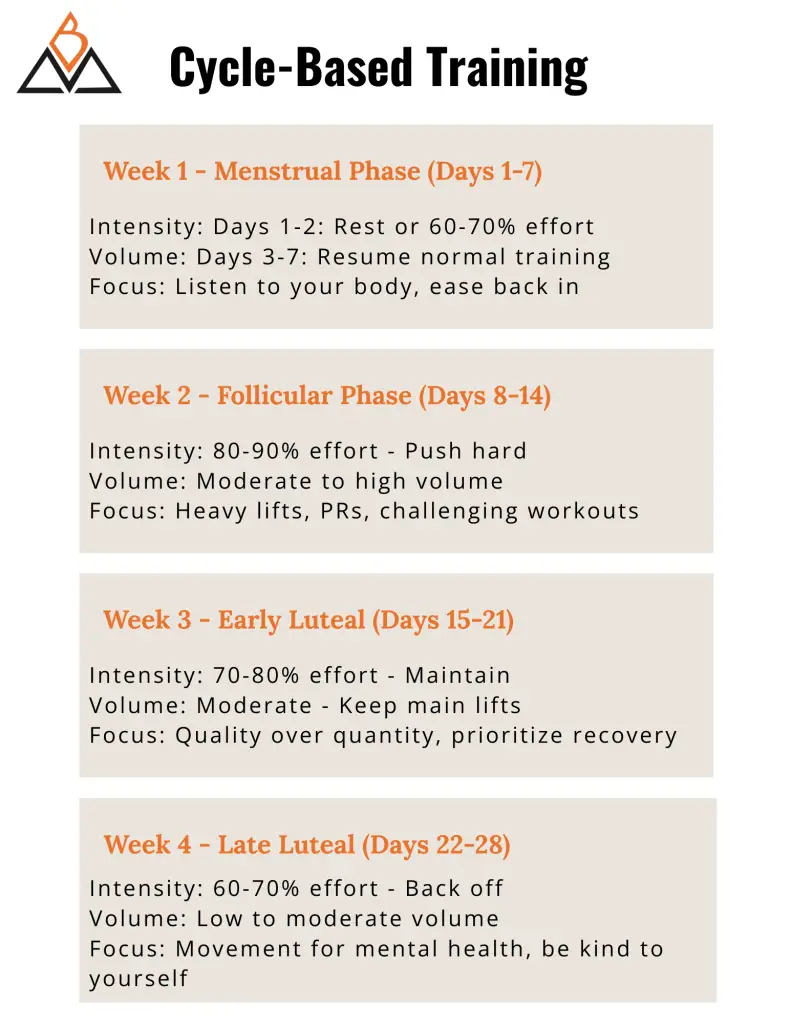
This template provides a general framework based on typical hormonal patterns. Your individual experience may vary. Track your energy, performance, and symptoms for 2-3 cycles to identify your personal patterns, then adjust this template accordingly. The goal is sustainable training that works with your body, not against it.
Special Considerations
Birth Control and Cycle-Based Training
Hormonal birth control (pill, IUD, implant, ring) suppresses your natural hormone fluctuations. If you’re on birth control, you won’t experience the same hormonal phases, which means cycle-based training may not apply to you in the same way.
Some women on birth control still notice energy fluctuations during their withdrawal bleed week, but this is different from the natural hormonal shifts of a normal menstrual cycle. You may still benefit from periodizing your training, but base it on how you feel rather than trying to align with cycle phases that aren’t actually occurring hormonally.
Irregular Cycles or PCOS
If your cycles are irregular or you have PCOS, tracking cycle phases becomes more challenging. Instead of trying to align working out on your period with predicted phases, focus on tracking how you actually feel on a daily or weekly basis.
Keep a simple training log that notes energy levels, strength, and how workouts felt. Look for patterns over time. You might discover that you have personal rhythms that don’t align perfectly with a 28-day cycle but still show consistent fluctuations.
For women with PCOS, strength training and consistent exercise are particularly beneficial for managing insulin sensitivity and metabolic health. Our Core program is designed to support women managing hormonal concerns and metabolic health.
Perimenopause and Menopause
As you approach menopause, your cycles become less predictable and hormone levels fluctuate more erratically. You might experience longer cycles, shorter cycles, or skipped periods. This makes cycle-based training less practical.
During perimenopause, focus on listening to your body day-to-day rather than trying to follow a rigid monthly template. Some days you’ll feel strong and energetic; other days you’ll feel depleted. Adjust training intensity based on how you actually feel rather than where you think you should be in your cycle.
After menopause, estrogen and progesterone levels remain consistently low. You won’t have the monthly fluctuations that affect training, but you also lose the muscle-building benefits of high estrogen phases. Consistent strength training becomes even more important for maintaining muscle mass and bone density.
Common Mistakes to Avoid
Pushing Through Severe Symptoms
There’s a difference between feeling slightly low energy and experiencing debilitating cramps, extremely heavy bleeding, or significant pain. If your symptoms are severe, rest is not weakness—it’s appropriate self-care. Forcing yourself through brutal workouts when you’re dealing with severe period symptoms doesn’t make you tougher; it just makes you more exhausted.
Expecting Linear Progress Every Week
You won’t set PRs every week when you’re training with your cycle. Some weeks you’ll feel strong and make progress. Other weeks you’ll maintain or even step back slightly. This is normal and expected. Progress happens in waves, not in a straight line.
Restricting Food During the Luteal Phase
Your body genuinely needs more calories during the luteal phase due to increased metabolic rate. If you’re experiencing intense cravings and hunger, your body is telling you something real. Aggressive calorie restriction during this time fights against your physiology and makes PMS symptoms worse.
Comparing Yourself to Men’s Training Programs
Men’s hormone levels remain relatively stable day-to-day and week-to-week. They can push hard consistently without needing to account for cyclical hormonal changes. Women’s physiology works differently. Trying to follow a training program designed for male hormonal patterns ignores the reality of how your body functions.
Ignoring Individual Variation
Every woman experiences her cycle differently. Some notice dramatic energy shifts between phases; others notice minimal changes. Some have severe PMS; others barely notice the luteal phase. Don’t force yourself into a template that doesn’t match your actual experience. Use cycle-based training as a framework, then adjust based on what you observe in your own body.
Tracking Your Cycle and Training Response
To train effectively when working out on your period and throughout your cycle, you need to understand your personal patterns. Everyone’s experience is different, and what works for another woman might not work for you.
What to Track
Keep a simple log that includes:
- Cycle day (Day 1 = first day of period)
- Energy level (1-10 scale)
- Strength/performance in workouts
- How hard training felt (rate of perceived exertion)
- Mood and motivation
- Any PMS symptoms
- Sleep quality
You don’t need a complicated system. A notes app, spreadsheet, or period tracking app with custom fields works fine.
Looking for Patterns
After tracking for 2-3 cycles, look for patterns. Do you consistently feel strongest during days 10-14? Do you always struggle with motivation during days 22-28? Does your performance dip right before your period starts?
Once you identify your personal patterns, you can plan training accordingly. Schedule challenging workouts during your strong phases and plan easier sessions or rest days during phases when you consistently feel depleted.
Adjusting Based on Data
Your patterns may not perfectly match the textbook description of cycle phases. Maybe you feel strongest in the early luteal phase rather than during ovulation. Maybe you bounce back quickly after day 2 of your period and feel great by day 3. Trust your data over general guidelines.
The Bottom Line
Working out on your period and across your entire cycle, is not an obstacle to training. Your menstrual cycle is information. Understanding how hormones affect your energy, strength, and recovery allows you to work with your body rather than fighting against it. You don’t need to train through severe pain or exhaustion to prove your dedication. You don’t need to ignore your body’s signals. Strategic adjustment isn’t weakness; it’s smart training.
Push hard when your body is primed for it during the follicular phase and ovulation. Maintain and consolidate during the luteal phase. Give yourself permission to rest when your body needs it during your period. This approach leads to better long-term progress than trying to force the same intensity every single week regardless of where you are in your cycle. The goal is sustainable, enjoyable training that respects your physiology. When you align training with your cycle, you’ll feel stronger, recover better, and make more consistent progress over time.
FAQs About Working Out on Your Period
Yes, it’s safe to lift heavy during your period if you feel up to it. There’s no medical reason to avoid heavy lifting during menstruation. However, if you’re experiencing severe cramping, fatigue, or heavy bleeding, you might not feel like pushing maximum effort, and that’s okay. Scale intensity based on how you actually feel, not on assumptions about what you should or shouldn’t do during your period.
During the late luteal phase (the week before your period), rising progesterone and falling estrogen change how your body responds to training. Progesterone increases your resting heart rate, reduces muscle protein synthesis, and can contribute to feelings of fatigue. You’re not actually weaker, but the same level of effort feels harder. This is a normal physiological response to hormonal changes.
Yes, especially during the luteal phase (days 15-28). Your resting metabolic rate increases by approximately 5-10% during this phase due to progesterone, meaning you burn more calories at rest. If you’re also training, your energy needs are legitimately higher. Don’t aggressively restrict calories during this time. Adequate nutrition supports recovery and helps manage PMS symptoms.
For many women, moderate exercise actually reduces menstrual cramps. Movement increases blood flow, releases endorphins (natural pain relievers), and can help relax uterine muscles. Light to moderate cardio, walking, or gentle strength training often helps more than complete rest. However, if you have severe cramping or conditions like endometriosis, listen to your body and consult with a healthcare provider about what’s appropriate for you.
Hormonal birth control suppresses your natural hormone fluctuations, so you won’t experience the same cyclical changes in energy and performance. Some women on birth control still notice fluctuations during their withdrawal bleed week, but these are different from natural menstrual cycle hormone shifts. You may not need to adjust training based on cycle phases, but pay attention to how you feel and adjust accordingly. Some forms of birth control (like certain IUDs or continuous-use pills) eliminate periods entirely, in which case cycle-based training won’t apply.
Yes, it’s safe to lift heavy during your period if you feel up to it. There’s no medical reason to avoid heavy lifting during menstruation. However, if you’re experiencing severe cramping, fatigue, or heavy bleeding, you might not feel like pushing maximum effort, and that’s okay. Scale intensity based on how you actually feel, not on assumptions about what you should or shouldn’t do during your period.
During the late luteal phase (the week before your period), rising progesterone and falling estrogen change how your body responds to training. Progesterone increases your resting heart rate, reduces muscle protein synthesis, and can contribute to feelings of fatigue. You’re not actually weaker, but the same level of effort feels harder. This is a normal physiological response to hormonal changes.
Yes, especially during the luteal phase (days 15-28). Your resting metabolic rate increases by approximately 5-10% during this phase due to progesterone, meaning you burn more calories at rest. If you’re also training, your energy needs are legitimately higher. Don’t aggressively restrict calories during this time. Adequate nutrition supports recovery and helps manage PMS symptoms.
For many women, moderate exercise actually reduces menstrual cramps. Movement increases blood flow, releases endorphins (natural pain relievers), and can help relax uterine muscles. Light to moderate cardio, walking, or gentle strength training often helps more than complete rest. However, if you have severe cramping or conditions like endometriosis, listen to your body and consult with a healthcare provider about what’s appropriate for you.
Hormonal birth control suppresses your natural hormone fluctuations, so you won’t experience the same cyclical changes in energy and performance. Some women on birth control still notice fluctuations during their withdrawal bleed week, but these are different from natural menstrual cycle hormone shifts. You may not need to adjust training based on cycle phases, but pay attention to how you feel and adjust accordingly. Some forms of birth control (like certain IUDs or continuous-use pills) eliminate periods entirely, in which case cycle-based training won’t apply.