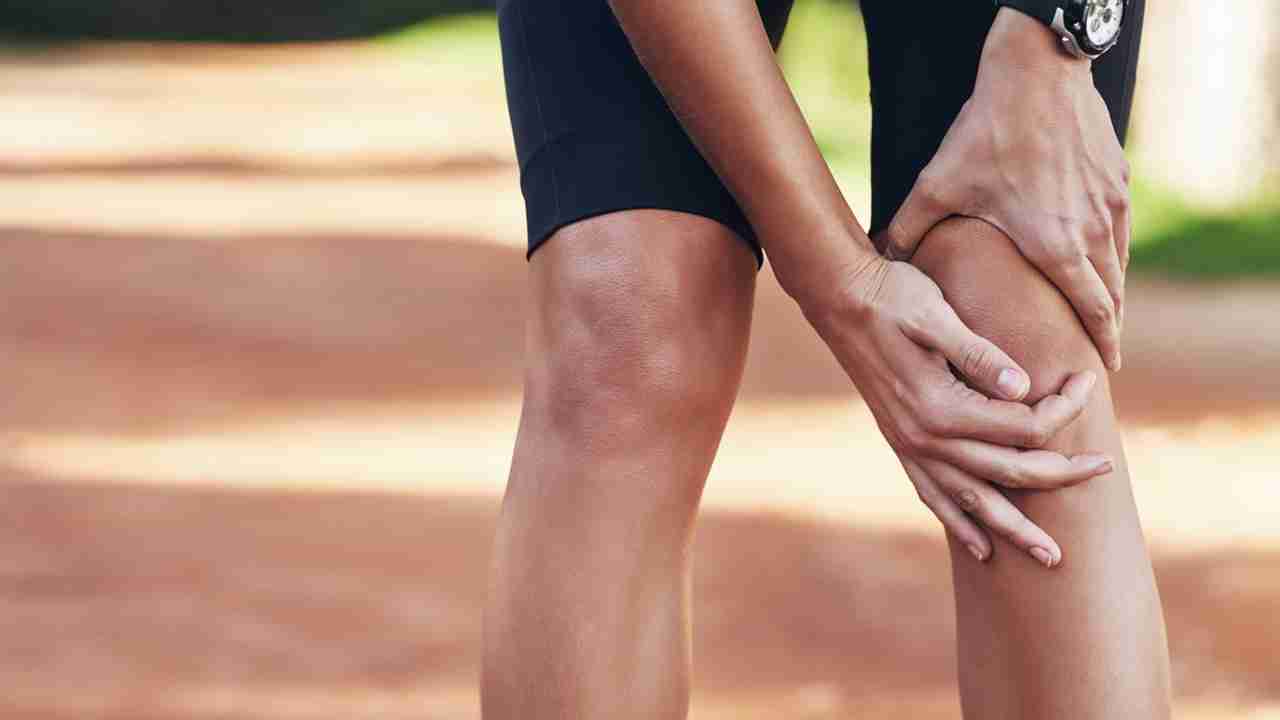
If you’ve ever felt that nagging ache around your kneecap during or after running, you’re dealing with runner’s knee. It’s frustratingly common, about 40% of running injuries involve the knee and it has a way of derailing your training just when you’re building momentum.
The good news: runner’s knee responds well to the right exercises. The key isn’t rest alone or generic stretching, it’s strengthening specific muscles that support your knee and addressing the movement patterns that caused the problem in the first place.
Here are seven exercises that target the exact weaknesses behind runner’s knee.
What Is Runner’s Knee (And Why Do You Have It)?
Runner’s knee, clinically called patellofemoral pain syndrome, describes pain around or behind your kneecap. Most people feel it:
- Directly under the kneecap (most common)
- Around the edges of the kneecap, especially on the outer edge
- Deep behind the kneecap, like the pain is coming from inside the knee joint
- Sometimes radiating slightly above or below the kneecap
The pain typically feels like a dull ache that worsens during specific activities. Running (especially downhill), squatting, going down stairs, and kneeling all tend to aggravate it. Sitting with bent knees for extended periods, like during a long car ride or movie, also triggers pain. You might also hear or feel grinding, clicking, or popping sensations around your kneecap during movement.
What Causes the Pain
The underlying cause usually isn’t damage to the knee itself—it’s weakness or imbalance in the muscles that control how your knee moves. When your hips, glutes, and quadriceps aren’t strong enough or aren’t working properly together, your kneecap doesn’t track correctly through its groove. Friction and irritation develop between the back of your kneecap and the femur (thigh bone), creating that familiar anterior knee pain.
Common contributing factors include:
- Weak hip muscles (especially glute medius)
- Tight hip flexors and IT band
- Overstriding while running
- Sudden increases in training volume or intensity
- Inadequate recovery between runs
- Poor footwear or consistently running on cambered surfaces
Understanding that runner’s knee stems from movement dysfunction or bad form rather than knee damage itself changes your approach to treatment. You’re not just trying to rest until pain subsides, you’re actively correcting the strength imbalances and movement patterns that created the problem.
“If runner’s knee keeps coming back despite doing the right exercises, a gait analysis with a running coach can identify the movement pattern causing it. That way you know exactly what you need to fix in your training to avoid the injury.
The 7 Best Runner’s Knee Exercises
These exercises target the specific weaknesses that contribute to runner’s knee. Perform this routine 3-4 times per week, even after pain subsides, to prevent recurrence. The following sections explain why each exercise fixes runner’s knee, understanding the biomechanics helps you perform them with better intention and focus.
1. Glute Bridge
Why this fixes runner’s knee:
Your glutes control what happens at your knee during every single stride. When you run, your glute max extends your hip to propel you forward, while your glute medius prevents your pelvis from dropping on the opposite side. This pelvic stability keeps your femur (thigh bone) from rotating inward, which would cause your knee to collapse toward your midline.
When your glutes are weak, your quadriceps try to compensate for both hip extension and stability. This overworks your quads while simultaneously changing the angle at which your quad muscles pull on your kneecap. The result: your kneecap gets pulled out of its ideal tracking pattern, creating friction and inflammation with every step.
The glute bridge rebuilds the posterior chain strength that takes load off your quads. As your glutes get stronger, they reclaim their role in hip extension, allowing your quads to focus on what they’re supposed to do, control your knee, rather than compensating for weak hips.
Key coaching point: If you feel this primarily in your hamstrings or lower back, your glutes aren’t activating properly. Focus on squeezing your glutes hard at the top position.
Target: 3 sets of 15-20 reps, progressing to single-leg variations
2. Clamshells
Why this fixes runner’s knee:
Your glute medius sits on the side of your hip and has one critical job during running: keeping your femur from rotating inward when all your weight lands on one leg. Every time your foot strikes the ground during running, you’re momentarily on one leg supporting your entire body weight plus the impact force of landing. If your glute medius can’t stabilize your femur in that moment, your thigh bone rotates inward.
This inward rotation (called internal rotation and adduction) causes your knee to dive toward your midline—the classic “knee valgus” or “knocked knee” position. When your knee moves inward like this, your kneecap no longer tracks straight through its groove. Instead, it gets pulled at an angle, grinding against the side of the groove with every step.
The clamshell isolates your glute medius in a position where it can’t cheat by using other muscles. This forces the muscle to strengthen in the exact movement pattern it needs for running: controlling femoral rotation while your hip is flexed (bent). As this muscle strengthens, it gains the endurance to maintain proper femoral position throughout your entire run, not just the first mile.
Key coaching point: You should feel a deep burn in the meat of your hip, not in the front of your hip or your outer thigh. If you’re feeling it in the wrong place, you’re likely rotating your pelvis backward to lift higher, keep your pelvis stacked.
Target: 3 sets of 15-20 reps per side
3. Side-Lying Hip Abduction
Why this fixes runner’s knee:
While the clamshell works your glute medius with your hip bent, this exercise trains the same muscle with your hip extended—which more closely mimics the position your hip is in during the stance phase of running. This positional difference matters because muscles function differently depending on joint angle.
During running, your hip isn’t flexed to 90 degrees like in a clamshell. Your hip is relatively extended, especially during the powerful push-off phase when you’re generating forward propulsion. Training your glute medius in this extended position builds the specific strength pattern your hip needs during actual running.
Beyond just strengthening, this exercise also addresses a common compensation pattern: lateral pelvic drop. When you run, if your standing, leg glute medius is weak, your opposite hip drops down. Your body interprets this as instability and responds by shifting your weight over your standing leg more aggressively, which increases the load on your knee. Building lateral hip stability through this exercise reduces that excessive lateral weight shift, distributing forces more evenly through your leg.
Key coaching point: Keep your toe pointing forward or angled slightly down. If your hip rolls backward and your toe points up, you’re shifting the work from your glute medius to your hip flexor.
Target: 3 sets of 12-15 reps per side
4. Terminal Knee Extensions (TKEs)
Why this fixes runner’s knee:
The VMO (vastus medialis oblique) is the portion of your quadriceps that runs along the inner part of your thigh near your knee. This muscle has a unique role: it pulls your kneecap inward and slightly upward, counteracting the tendency of your other quad muscles to pull the kneecap outward.
When your VMO is weak relative to the other parts of your quadriceps (especially the vastus lateralis on the outer thigh), your kneecap gets pulled laterally; toward the outside of your knee. Your kneecap then rubs against the outer edge of its groove instead of gliding smoothly through the center. Over thousands of running strides, this creates the friction and inflammation you feel as runner’s knee pain.
Your VMO works hardest in the last 15-20 degrees of knee extension, which is exactly where terminal knee extensions train it. This end-range strength is also critical for running. Your knee reaches near-full extension during the push-off phase of your stride, and if your VMO isn’t strong enough to keep your kneecap centered during this phase, tracking problems occur.
Training this end-range strength pattern specifically addresses the mechanical dysfunction causing your pain, rather than just building general quad strength.
Key coaching point: As you straighten your leg against the band, actively think about pulling your kneecap upward. This cue helps activate the VMO specifically.
Target: 3 sets of 15-20 reps per leg
5. Step-Downs
Why this fixes runner’s knee:
Running is essentially a series of controlled single-leg landings. Every time your foot hits the ground, your leg has to eccentrically control the descent of your body weight, your muscles are lengthening under tension to slow you down and absorb impact.
Step-downs specifically train this eccentric control in your quadriceps, which is exactly what fails when you have runner’s knee. When your quads aren’t strong enough to eccentrically control your body’s descent during landing, two problems emerge. First, your knee collapses inward (that same knee valgus pattern we’ve been talking about) because your muscles can’t resist the inward forces. Second, you land harder than you should, creating excessive impact that your kneecap has to absorb.
Step-downs also reveal and address asymmetries between your legs. Most people with runner’s knee in one knee have significantly weaker eccentric control on that side. When you perform step-downs, you’ll likely notice your painful knee shakes, collapses inward, or gives you a wobbly feeling much more than your other leg. That instability is exactly what’s happening during running. You’re just noticing it more because the step-down slows the movement down and removes momentum.
By building eccentric quad strength and single-leg stability, step-downs retrain the exact motor control pattern that breaks down during running when you have runner’s knee.
Key coaching point: The lowering (eccentric) phase is what matters, this should take 2-3 seconds. Watch your knee to make sure it tracks over your second toe rather than collapsing inward.
Target: 3 sets of 10-12 reps per leg, starting with a 4-6 inch step height
6. Wall Sits with Ball Squeeze
Why this fixes runner’s knee:
Endurance matters as much as strength when it comes to running injuries. Your quads might be strong enough for the first mile, but what happens at mile 5? Mile 8? When your quads fatigue during longer runs, they lose the ability to maintain proper kneecap alignment. This is why runner’s knee pain often starts partway through a run rather than immediately.
Wall sits build muscular endurance, your quads’ ability to maintain contraction over time without fatiguing. The isometric hold (static contraction without movement) specifically trains the type of endurance your quads need during running’s stance phase. During this phase, your knee is partially bent and your quad has to hold tension to support your body weight.
The ball squeeze between your knees adds an important element: it activates your adductors (inner thigh muscles) and creates something called “irradiation.” This happens when you maximally contract one muscle group and nearby muscles automatically increase their activation. Specifically, squeezing the ball increases VMO activation. Your VMO and adductors share fascial connections and work together to pull your kneecap medially (inward), so training them together makes functional sense.
This combination, quad endurance plus adductor activation, addresses both the fatigue component and the tracking component of runner’s knee simultaneously.
Key coaching point: Maintain the ball squeeze throughout the entire hold, don’t let it soften as you fatigue. This sustained contraction is what drives the VMO activation.
Target: 3-4 holds of 30-45 seconds, progressing toward 60 seconds
7. Single-Leg Deadlift
Why this fixes runner’s knee:
All the previous exercises isolate specific muscles or movement patterns. This one integrates everything together the way your body actually has to coordinate during running.
When you run, you’re never moving just one joint at a time. Your hip, knee, and ankle all have to work together in a coordinated chain, with proper timing and force distribution between muscles. If this coordination breaks down, you get movement dysfunction that shows up as knee pain. This happens when your hip extends before your knee stabilizes, or when your glute doesn’t fire before your quad tries to compensate.
Single-leg deadlifts force your nervous system to organize this whole-body stability pattern while balancing on one leg. Your standing leg has to simultaneously stabilize your ankle, control knee alignment, and create hip hinge movement. Meanwhile, your glutes work to keep your pelvis level. This is the exact coordination challenge your body faces during the single-leg stance phase of running.
This exercise also reveals balance and stability deficits that less challenging exercises might mask. If you wobble significantly during this movement or feel like you’re going to fall over, that instability exists during running too. You just compensate for it unconsciously through other movement patterns that stress your knee.
By improving single-leg balance and training your hip, knee, and ankle to work together as a coordinated system, this exercise bridges the gap between isolated strengthening and actual running movement.
Key coaching point: Feel the work in your glute and hamstring of your standing leg, not in your lower back. Keep your hips level, don’t let your non-stance hip hike up.
Target: 3 sets of 10-12 reps per leg, starting bodyweight and progressing to light dumbbell
How to Structure Your Rehab Program
Start these exercises at lower volumes and progress gradually. Even though you might be eager to fix your knee pain quickly, rushing the process often backfires.

The timeline above provides a general framework. Listen to your body and adjust based on how your knee responds. Some mild discomfort during strengthening is normal, but sharp pain or pain that worsens means you’re pushing too hard. For comprehensive guidance on integrating strength training with running, see our guide on combining gym and running.
What to Do About Pain During Exercises
Some exercises might cause mild discomfort, especially in the beginning. Here’s how to distinguish between productive discomfort and problematic pain:
- Acceptable: Muscle fatigue or burning during the exercise, mild muscle soreness 24-48 hours after exercising, temporary stiffness that improves with movement.
- Not acceptable: Sharp pain during the exercise, pain that persists after the exercise ends, swelling around your knee, pain that worsens over multiple sessions.
If you experience unacceptable pain, reduce the range of motion (for step-downs, use a lower step height), decrease resistance or reps, or substitute a less aggravating variation of the exercise. Some exercises might feel fine while others trigger symptoms. That’s normal, continue the pain-free exercises and work around the problematic ones initially, progressing to them as your knee improves.
Common Mistakes That Slow Recovery
- Rushing back to running too soon. Just because the pain decreases doesn’t mean the underlying weakness has fully resolved. Give your strengthening program at least 3-4 weeks before significantly increasing running volume. If you return to running too quickly, you’ll likely re-irritate your knee and restart the cycle.
- Stopping exercises when pain resolves. Runner’s knee will return if you stop the exercises that fixed it. The strength imbalances that caused your knee pain didn’t develop overnight, and they’ll return if you don’t maintain the strength you’ve built. Keep doing these exercises 2-3 times per week even after you’re pain-free.
- Only doing stretching. While flexibility matters, runner’s knee is primarily a strength and motor control issue, not a flexibility issue. Stretching alone rarely fixes runner’s knee. You need to build strength in the muscles that control knee alignment.
- Ignoring running form. If your running mechanics contributed to your knee pain, overstriding, excessive forward lean, or crossing your midline with your feet, the pain will return unless you address these patterns. Consider working with a running coach or doing form drills as part of your return-to-running process.
- Not addressing training errors. If you developed runner’s knee after rapidly increasing mileage, switching to hillier routes, or changing shoes, those training variables likely contributed to the problem. Address these factors alongside your strengthening program.
When to Seek Professional Help
Most cases of runner’s knee respond well to the exercises outlined here, but some situations require professional assessment.
Seek help from a physical therapist or sports medicine provider if:
- Pain persists despite 6-8 weeks of consistent strengthening
- Pain occurs during normal walking or daily activities (not just running)
- You experience significant swelling or instability in your knee
- Pain is accompanied by locking, clicking, or giving way
- You’ve had runner’s knee multiple times in the same knee
A physical therapist can assess your specific movement patterns and identify contributing factors unique to your case. They can also modify the exercise program based on your individual needs.
For runners in the Toronto area dealing with persistent knee pain or looking for personalized guidance on returning to running after injury, the Flex program provides individualized programming. It balances running and strength training while accounting for injury history.
Preventing Runner’s Knee From Coming Back
Once your knee feels better, prevention becomes the priority. Continue strength training 2-3 times per week focusing on hip and knee strength. Increase running volume gradually; no more than 10% per week. Include rest days in your training schedule rather than running consecutive days without recovery.
Address training errors like doing too much too soon, inadequate footwear, or always running on the same cambered surface. Pay attention to early warning signs. These include mild knee discomfort that doesn’t improve during the run or stiffness that lasts longer than usual after running.
Many runners develop runner’s knee because they focus exclusively on running without addressing the strength foundation needed to support higher training volumes. Building and maintaining strength in your hips, glutes, and quadriceps isn’t optional if you want to run consistently without injury. It’s a fundamental part of being a healthy runner.
For runners looking to build a comprehensive strength training program that supports running performance while preventing common injuries, our strength training guide for runners provides detailed programming guidance.
The Bottom Line
Runner’s knee is frustrating, but it’s not a life sentence. The exercises in this article address the root causes, weak hips and poor movement patterns, rather than just treating symptoms. Give your body time to adapt to the strengthening work, be patient with the process, and maintain the strength you build even after pain resolves.
Most importantly, recognize that strength training isn’t separate from running, it’s what makes sustainable running possible. The runners who stay healthy long-term are the ones who invest in building a strong foundation that supports their running goals.
Book a free discovery call to discuss personalized strength training programming that addresses your specific injury history and running goals.
FAQs About Runner’s Knee
Runner’s knee causes pain around or behind your kneecap, usually worsening with activities like squatting or going downstairs. IT band syndrome causes pain on the outside of your knee, typically occurring during runs at a consistent distance and improving quickly when you stop running. Both respond well to hip strengthening, but IT band syndrome often requires more focus on foam rolling and IT band stretches.
Knee braces or straps might provide temporary symptom relief by changing how forces distribute across your knee, but they don’t address the underlying strength imbalances causing the problem. Use them if they help you stay active during recovery, but don’t rely on them long-term instead of doing strengthening exercises. The goal is to build enough strength that your muscles provide the support a brace would.
Most cases of runner’s knee improve significantly within 4-8 weeks of consistent strengthening and modified activity. However, full resolution often takes 8-12 weeks, especially if you’re returning to previous running volume. The timeline depends on how consistently you do the exercises, whether you adequately reduce running volume during initial recovery, and how long you’ve had the pain before addressing it.
Knee braces or straps might provide temporary symptom relief by changing how forces distribute across your knee, but they don’t address the underlying strength imbalances causing the problem. Use them if they help you stay active during recovery, but don’t rely on them long-term instead of doing strengthening exercises. The goal is to build enough strength that your muscles provide the support a brace would.
Sometimes runner’s knee resolves with rest alone, but it almost always returns when you resume running unless you address the underlying weakness. Rest treats the symptoms but doesn’t fix the cause. Strengthening the muscles that control your knee alignment and improving your running mechanics gives you the best chance of long-term resolution.
Most cases of runner’s knee improve significantly within 4-8 weeks of consistent strengthening and modified activity. However, full resolution often takes 8-12 weeks, especially if you’re returning to previous running volume. The timeline depends on how consistently you do the exercises, whether you adequately reduce running volume during initial recovery, and how long you’ve had the pain before addressing it.
You can continue running if pain is mild and doesn’t worsen during or after runs. However, you’ll likely need to reduce volume and intensity while focusing on strengthening. If running significantly aggravates pain or causes limping, stop running temporarily and focus exclusively on strengthening until pain decreases. Many runners can maintain some running during recovery by cutting volume in half and avoiding hills and speed work.
Runner’s knee causes pain around or behind your kneecap, usually worsening with activities like squatting or going downstairs. IT band syndrome causes pain on the outside of your knee, typically occurring during runs at a consistent distance and improving quickly when you stop running. Both respond well to hip strengthening, but IT band syndrome often requires more focus on foam rolling and IT band stretches.
Knee braces or straps might provide temporary symptom relief by changing how forces distribute across your knee, but they don’t address the underlying strength imbalances causing the problem. Use them if they help you stay active during recovery, but don’t rely on them long-term instead of doing strengthening exercises. The goal is to build enough strength that your muscles provide the support a brace would.
Sometimes runner’s knee resolves with rest alone, but it almost always returns when you resume running unless you address the underlying weakness. Rest treats the symptoms but doesn’t fix the cause. Strengthening the muscles that control your knee alignment and improving your running mechanics gives you the best chance of long-term resolution.